
Last updated September 25, 2026
Non-destructive entry first, always - and we re-key Schlage, Kwikset, and Baldwin locks on the spot while you watch
You get a price before we start. It does not change when we arrive. No surprises.
Commercial Locksmith Maintenance Checklist for New York Homeowners
A failed panic bar on a fire egress door is not a locksmith problem. It is a NYC Fire Code violation that can trigger a vacate order on the spot. Most commercial maintenance checklists skip this entirely, focusing on HVAC filters and light bulbs while the hardware that keeps people alive and insurers satisfied corrodes in plain sight. In New York, where buildings age fast, foot traffic is relentless, and the Department of Buildings does not issue warnings before it issues penalties, lock maintenance is a compliance discipline, not a handyman afterthought. This guide, alongside our The Complete Guide to Locksmith in New York, translates the obligations buried in NYC Fire Code Section 1010, OSHA egress rules, and standard commercial insurance policies into a quarterly inspection routine any facilities manager can execute and document.
Quick Answer
Commercial Locksmith services in New York require quarterly visual inspections of panic hardware, door closers, and key control logs; annual latch-force testing and master key audits; and immediate professional service when exit devices fail to release under 15 pounds of pressure or keys show evidence of unauthorized duplication. Documentation must include dated photos, hardware serial numbers, and technician credentials to satisfy both city inspectors and insurance carriers after an incident.
Table of Contents
- NYC Fire Code Panic Hardware Requirements
- Quarterly Inspection Routine: What Your Staff Can Handle
- Annual Tasks That Require a Licensed Locksmith
- Master Key System Audit Procedures
- ADA Compliance Checkpoints for NYC Commercial Entries
- Documentation Standards for Inspectors and Insurers
- Common Mistakes to Avoid
- When to Call a Professional
- Frequently Asked Questions
NYC Fire Code Panic Hardware Requirements
New York City Fire Code Section 1010 mandates panic hardware on any door serving an occupancy of 49 or more people. This covers restaurants, retail floors, office suites, assembly halls, and multi-tenant lobbies. The code is specific about function, not just presence. The latch must release when pressure is applied, the touchpad or crossbar must extend at least half the door width, and the mechanism must operate with no more than 15 pounds of force. A sticky panic bar that requires a shoulder or a second shove is a violation, even if it eventually opens.
We’ve inspected panic hardware in Midtown office buildings where the touchpad was painted over four times, in Lower East Side restaurants where grease had migrated from the kitchen into the mechanism, and in Brooklyn warehouses where seasonal expansion had shifted the door frame enough to bind the latch. In each case, the facilities manager assumed the hardware was “working” because it opened when tested with a palm. The DOB inspector who arrives after a complaint or a fire tests with a scale. Fifteen pounds is not a suggestion.
The hardware itself must be listed for fire exit use. We regularly encounter retrofit installations where a standard cylindrical lock was swapped for a panic bar by a general contractor who did not verify the door’s fire rating or the hardware’s UL listing. In a fire-rated assembly, every component, including the strike plate and the mounting screws, must be part of a tested system. A Sargent 8800 series or a Von Duprin 98/99 installed with non-rated fasteners is a failed inspection waiting to happen.
Key inspection points for panic hardware:
- Touchpad or crossbar moves freely through full travel with consistent resistance
- Latch retracts fully and does not drag on the strike
- Door closes and latches without bouncing or rattling
- No paint, corrosion, or debris in the mechanism housing
- Fasteners are present, tight, and original to the hardware listing
- Dogging feature (if present) is functional and used only during approved hours
Dogging allows the panic bar to be held retracted for free access during business hours. In New York, where many retail spaces operate with open doors during the day, dogging is common. But the key or hex wrench that controls it must be stored in a designated location known to staff, not on a hook in the manager’s office where a substitute keyholder cannot find it during an emergency.
Quarterly Inspection Routine: What Your Staff Can Handle
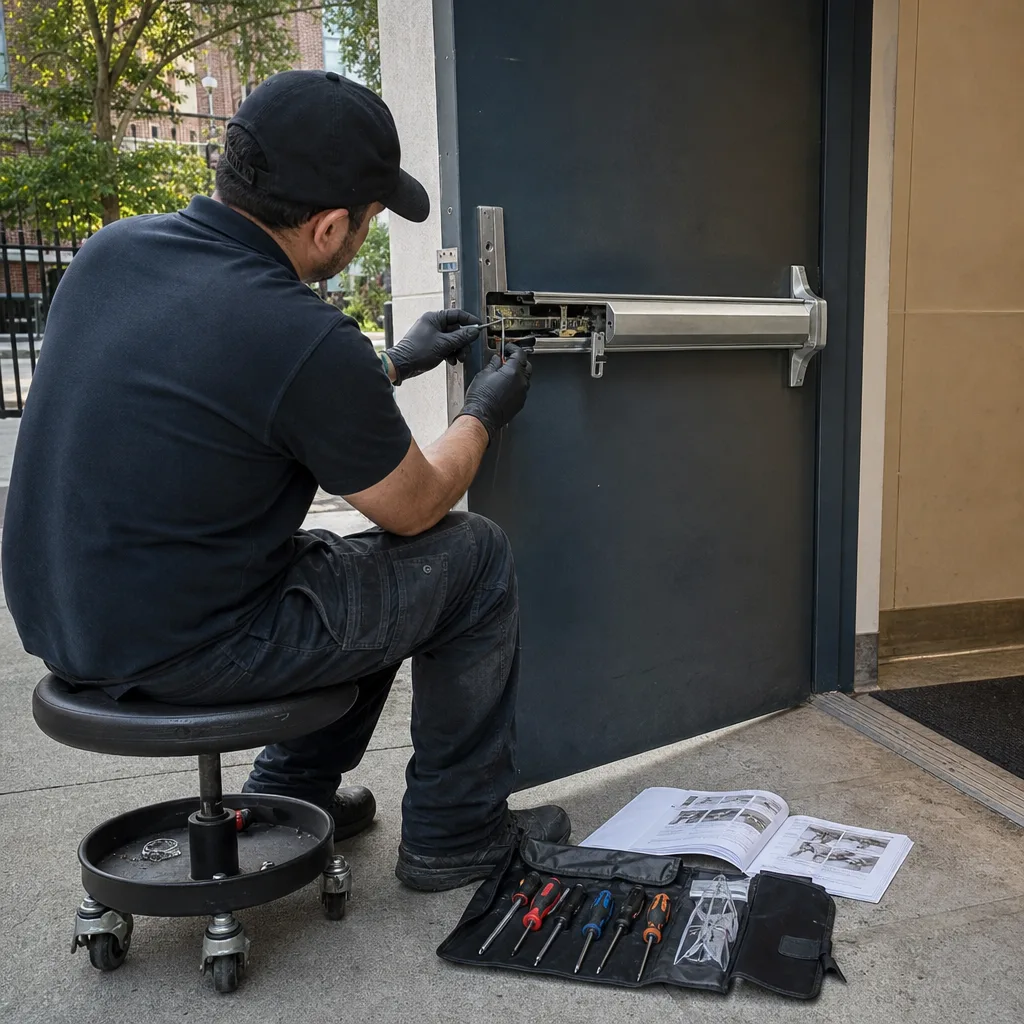
Not every checkpoint requires a locksmith. A trained facilities staff member can execute the quarterly routine in under 30 minutes per floor, provided they use a standardized form and understand what “normal” looks like for each hardware type. The goal is to catch degradation before it becomes a failure, and to generate dated evidence that the building owner exercised reasonable care.
We recommend scheduling these inspections in March, June, September, and December. March catches winter damage: salt corrosion on exterior hardware, frame shift from freeze-thaw cycles, and closer fluid thickening in unheated vestibules. September catches summer wear: expanded door frames creating latch misalignment, UV degradation of rubber seals that allow water into mechanisms, and the accumulated grit of open-door season.
- Visual sweep of all egress doors. Look for paint on hardware, missing screws, bent or cracked touchpads, and strike plates that have shifted from their original position. Photograph anything that has changed since the last inspection.
- Operational test of panic hardware. Apply steady pressure with one hand. The latch should release smoothly. If you need to adjust your stance or use two hands, the mechanism requires service. Note the door number and mark it for follow-up.
- Door closer check. Open the door to 90 degrees and release. It should swing closed in 3-5 seconds, latch without slamming, and not hesitate or accelerate in the final 15 degrees. In New York’s older buildings, closer arms often contact decorative plaster or signage; note these conflicts.
- Keyway inspection. Shine a light into every cylinder. Debris, corrosion, or a key broken off flush indicates immediate rekeying or cylinder replacement. Do not attempt to extract a broken key with pliers; the warding can be damaged, and the cylinder may fail to accept a replacement key.
- Exterior hardware weather check. Look for water staining below the escutcheon, indicating seal failure. In Manhattan and Brooklyn, where façade restoration and window replacement are constant, we’ve seen silicone sealant applied sloppily over lock cylinders by contractors who treated the hardware as part of the building envelope.
- Key control log review. Verify that all keys issued since the last quarter are recorded with recipient name, date, and expected return date. Flag any keys not returned within 30 days of expected return.
Document each inspection with the date, inspector initials, door numbers checked, and any findings. Store these records with your insurance documentation. After a slip-and-fall or an egress failure incident, the first question from both the carrier and the city is whether a maintenance program existed and was followed.
Annual Tasks That Require a Licensed Locksmith
Some maintenance is beyond staff capability or legal scope. Annual professional service covers the measurements, adjustments, and system-level audits that protect against code violations and coverage denials. We schedule these visits for January, when New York buildings are under maximum thermal stress and hardware failures are most revealing.
Latch-force testing with a calibrated gauge. The 15-pound maximum for panic hardware release is measured with a spring scale or force gauge, not by feel. A properly calibrated test documents the exact force required at each door. We record this in pounds, with the hardware serial number, and provide a dated certificate. In our experience, hardware that tests at 12 pounds in January will test at 17 or higher by August if the closer tension has been adjusted without regard to the panic bar’s resistance curve.
Door closer adjustment and fluid check. Closer back-check, sweep speed, and latch speed are interdependent. A staff member who adjusts one without understanding the others often creates a door that slams or fails to latch. We verify closer mounting security, check for fluid leakage at the arm pin, and adjust to ADA-compliant opening force while maintaining positive latching.
Cylinder removal and internal inspection. This requires the control key for interchangeable cores or a cylinder wrench for fixed cores. We inspect for wear on the plug, driver pins, and springs; measure key wear against factory specifications; and identify cylinders that have been rekeyed with non-original pinning. Mul-T-Lock and Abloy cylinders have specific wear patterns that indicate either normal use or attempted compromise. We’ve found drill marks on high-security cylinders in Queens commercial spaces where the owner was unaware of a break-in attempt.
Strike alignment and frame condition. Building settlement, especially in pre-war New York structures, shifts strike positions by fractions of an inch annually. A strike that was flush in 2023 may be binding by 2025. We measure latch engagement depth; 3/4 inch is the minimum for security, and full engagement is required for fire-rated assemblies. We also check for frame spread, where the strike jamb has moved away from the hinge jamb, creating a gap that defeats the latch.
Master key system hierarchy verification. This is detailed in the next section, but the annual locksmith visit includes a physical test of every key level, confirming that change keys do not operate outside their assigned suites and that master keys operate all assigned cylinders without excessive wear.
Pricing for annual commercial lock maintenance in New York typically runs $400-$800 per building for basic panic hardware and door closer service, with master key audits and high-security cylinder inspection adding $200-$500 depending on cylinder count. We quote this in writing before dispatch, per Haven Standard Clause 1: the price on the phone is the price on the invoice.
Master Key System Audit Procedures
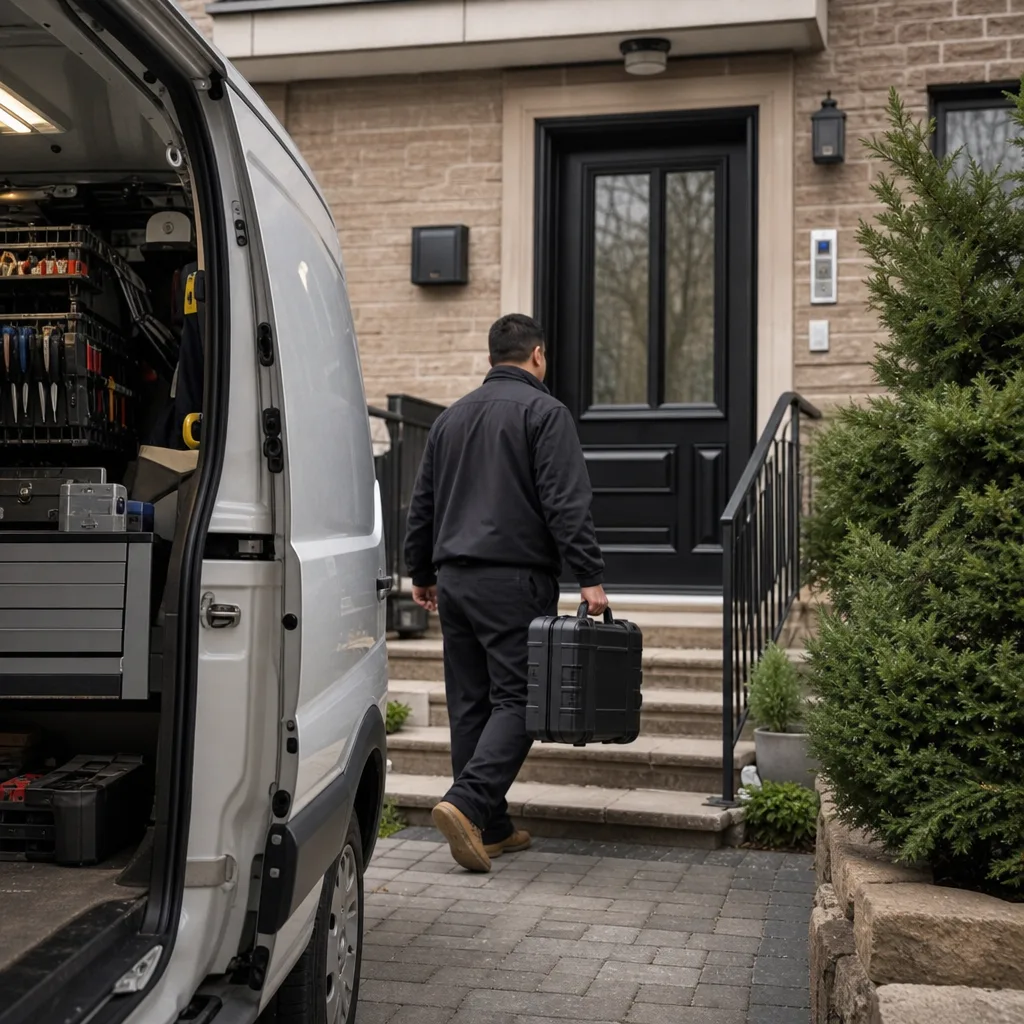
A master key system is a hierarchy of access levels: the change key opens one door, the master key opens a group, the grand master opens all groups. In New York commercial buildings, these systems often grow organically over years, with cylinders added by different locksmiths using different keyways, creating security gaps that no single person understands.
The annual audit has three components: physical key inventory, keyway analysis, and access log reconciliation.
Physical key inventory. Every key issued must be accounted for. This sounds elementary, but in our audits we typically find 10-15% of keys are not traceable to a current employee or contractor. The audit requires each key holder to present their key for inspection. We check the bitting against the factory record, looking for wear that indicates duplication (a copied key often has slightly rounded edges from the duplicator’s cutter) or damage that predicts failure.
Keyway analysis. We inspect each cylinder to confirm it matches the system specification. Unauthorized keyway changes, where a previous locksmith installed a Schlage cylinder in a Sargent system for convenience, create master key incompatibilities and security vulnerabilities. We also check for cylinders that have been drilled and repinned without documentation, a common shortcut that destroys the system’s mathematical integrity.
Access log reconciliation. The key control log is compared against HR records. Terminated employees with unreturned keys, contractors whose access was never formally revoked, and keys issued for “temporary” access that became permanent are flagged. In New York’s high-turnover retail and restaurant sectors, this is where most security exposure originates.
When to rekey versus recore: Rekeying changes the pin combination within the existing cylinder, rendering old keys inoperative. It is appropriate when keys are lost or unreturned, but the cylinder itself is sound. Recoring replaces the entire interchangeable core, appropriate when the cylinder shows wear, has been compromised, or requires a keyway change. Recoring is faster on site but requires a new control key and updated key records. For a typical New York commercial suite with 8-12 cylinders, rekeying runs $25-$45 per cylinder; recoring with a new high-security core runs $80-$150 per cylinder, quoted in writing before work begins.
ADA Compliance Checkpoints for NYC Commercial Entries
New York City Local Law 58 of 1987, incorporating the ADA Standards for Accessible Design, governs door hardware in commercial spaces. The requirements are specific and frequently violated in retrofit installations.
Lever hardware. Knobs are non-compliant on any door required to be accessible. The operating mechanism must be a lever, push-type, or U-shaped handle, operable with one hand without tight grasping, pinching, or twisting. We’ve replaced non-compliant knobs in SoHo retail spaces where the landlord installed decorative hardware without regard to accessibility law, exposing the tenant to civil liability.
Operating force. Interior doors must open with no more than 5 pounds of force. Exterior doors have no specific force limit but must meet the “readily achievable” standard for barrier removal. In practice, this means a door closer set to prevent wind blow-open may be ADA-noncompliant if it exceeds accessible opening force. We test with a force gauge and adjust closer spring power accordingly, documenting the setting.
Clear width and threshold. The door opening must provide 32 inches of clear width when open 90 degrees. Thresholds cannot exceed 1/2 inch in height, with beveled edges. In New York’s landmark districts, where original marble thresholds are protected, this creates conflict between preservation and accessibility. Solutions include recessed floor tracks or approved bevel inserts.
Vision lights and hardware height. Vision lights in doors must be positioned to provide sight lines for wheelchair users. Hardware must be mounted between 34 and 48 inches above the floor. We’ve encountered panic bars mounted at 52 inches to accommodate original door stile dimensions, a clear violation that the DOB accessibility unit will cite.
ADA compliance is not a one-time installation standard. Closer tension drifts, hinges sag, and thresholds shift. The quarterly inspection should include a visual check for lever condition and threshold integrity; the annual locksmith visit includes force testing and adjustment.
Documentation Standards for Inspectors and Insurers
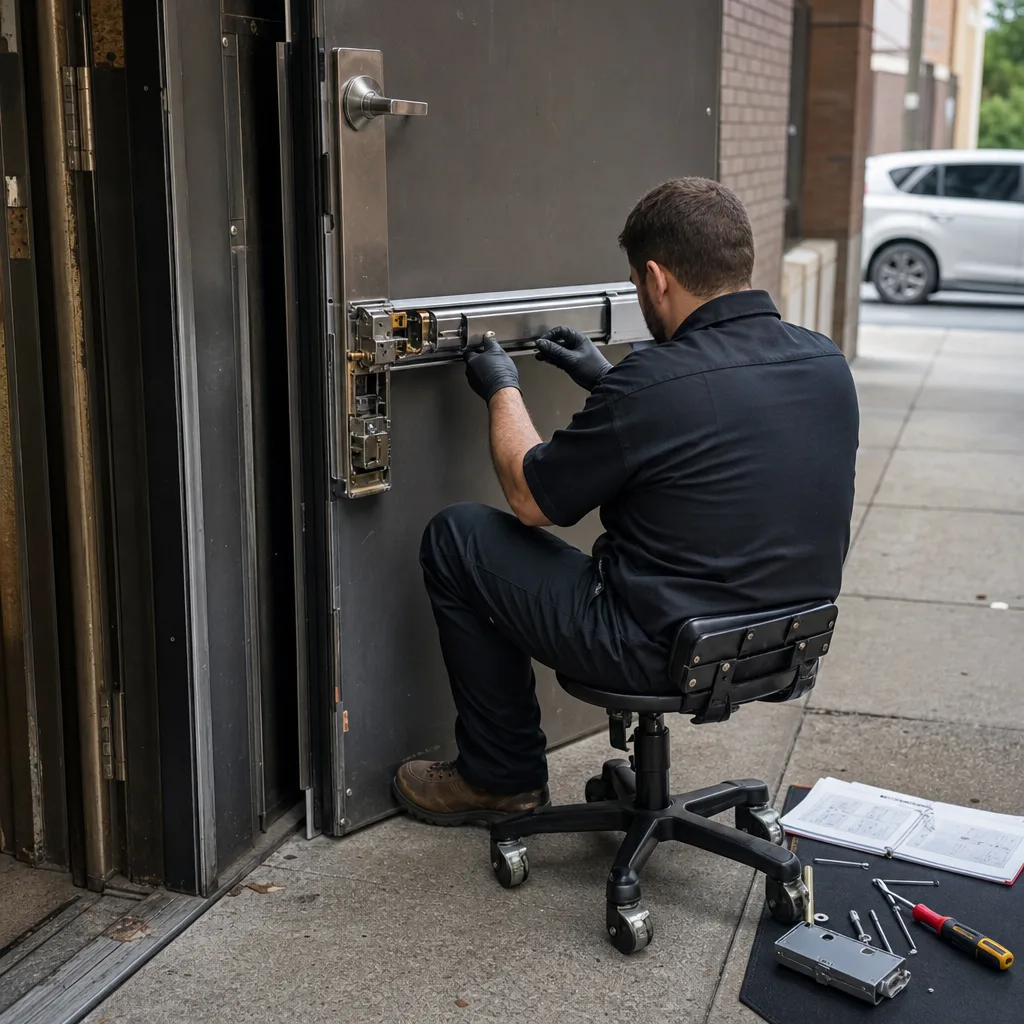
After an incident, the quality of your documentation determines whether your insurance carrier defends the claim or denies it for failure to maintain. New York courts have upheld denials where the insured could not produce evidence of regular inspection and prompt repair. The following documentation protocol satisfies both city inspectors and standard commercial general liability policies.
The inspection record. Each quarterly and annual inspection generates a dated report with: building address and floor; door number or location description; hardware manufacturer and model; serial number where visible; inspection findings with photographic evidence; any corrective action taken, with date and technician identification; and inspector signature or technician badge number.
The photo record. Novak Lock & Security New York provides a documented photo record on every visit as standard, not an upgrade, per The Haven Standard. Photos must show the overall door condition, close-ups of hardware, any defects found, and the post-repair state. Timestamp and geolocation data strengthen evidentiary value.
The work order and invoice. Every repair or adjustment generates a written scope and fixed-price invoice. Haven Standard Clause 1 requires that the price quoted on the phone be the price on the invoice, with no additions for “unexpected complications.” This protects the customer from dispute and creates a clean record for insurance review.
The key control log. Maintained separately from inspection records, this log tracks every key by serial number, bitting code (for systems where this is recorded), issue date, recipient, authorization, and return date. Annual reconciliation against the locksmith’s keyway analysis confirms system integrity.
Store all records for the duration of occupancy plus seven years, the standard statute of limitations for New York premises liability. Digital storage with cloud backup is acceptable; paper originals are not required if the digital record is auditable and tamper-evident.
Common Mistakes to Avoid
- Testing panic hardware with a shove instead of steady pressure. A shove generates variable force and masks binding. Use a scale or apply consistent palm pressure; if the mechanism hesitates, it fails the 15-pound test.
- Adjusting door closers without checking panic bar interaction. A closer set for faster latching increases the force required to release the panic bar. These are interdependent systems; adjust one, verify the other.
- Ignoring seasonal frame shift. New York’s freeze-thaw cycle moves steel and masonry differently. A door that latches in October may not latch in March. Quarterly inspection catches this; annual-only review does not.
- Accepting “equivalent” hardware substitutions. A fire-rated door assembly is tested as a system. Substituting a different brand or model of panic bar, even with comparable specifications, voids the rating unless specifically approved by the listing agency.
- Failing to document “no findings” inspections. An insurer or plaintiff’s attorney may claim no inspection occurred. A dated record showing “all hardware operational, no defects noted” is evidence of due diligence.
- Delaying rekeying after key loss. The exposure period between loss and rekeying is when unauthorized access occurs. In New York’s dense commercial environment, a lost key found on the sidewalk is likely in a lock within 48 hours.
- Assuming ADA compliance is the landlord’s responsibility. In commercial leases, accessibility liability often falls on the tenant for spaces under their exclusive control. Verify your lease and insure accordingly.
When to Call a Professional
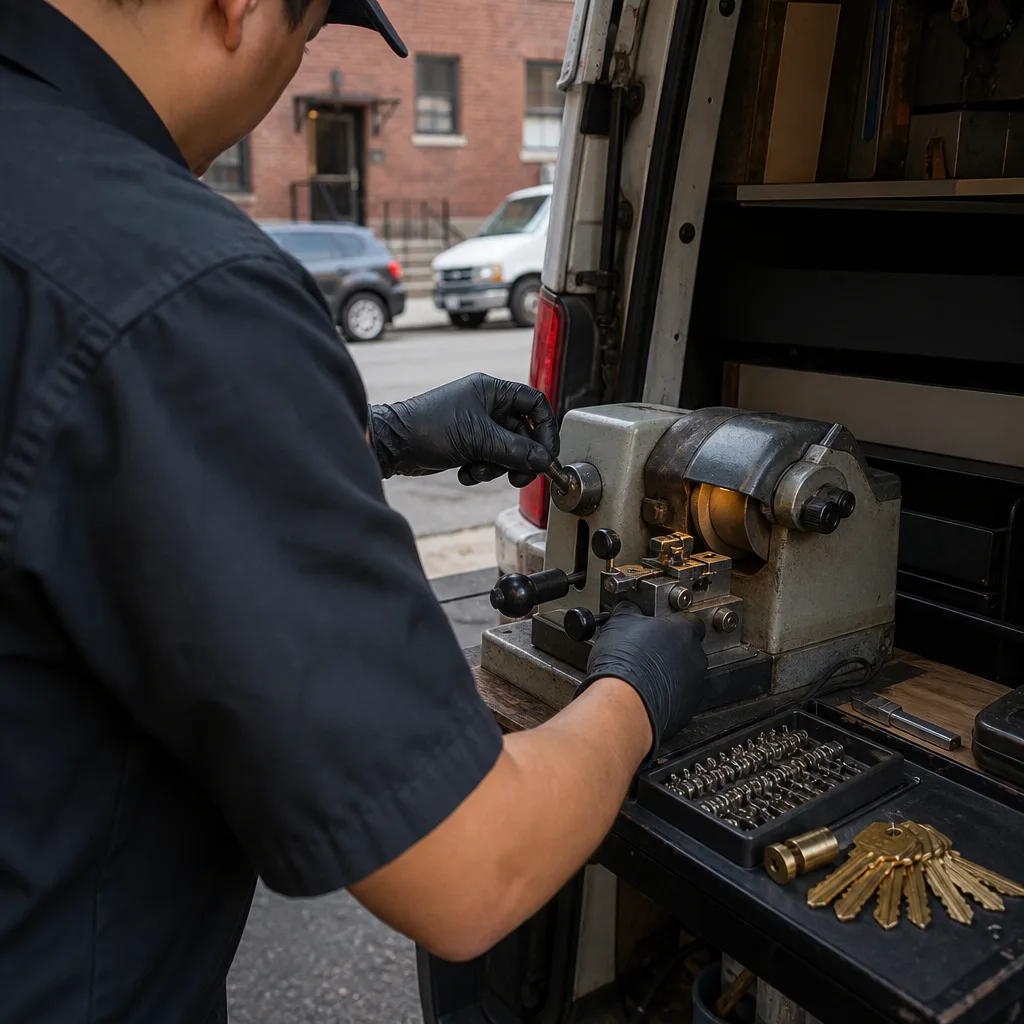
Call a licensed locksmith when panic hardware fails the 15-pound release test, when a cylinder shows drill marks or extraction damage, when door closer fluid is leaking, when frame shift has reduced latch engagement below 3/4 inch, or when your master key audit reveals untraceable keys or unauthorized keyway changes. These are not staff-level repairs; attempted DIY fixes on fire-rated hardware can void the listing and expose the building to liability, as explained in our DIY vs Professional Locksmith: The New York Homeowner’s Decision Guide.
Novak Lock & Security New York offers free estimates for commercial lock maintenance programs in New York, with more guides & resources available on our blog. We’ll survey your building, identify code-specific requirements, and provide a written scope and flat annual price. Every visit includes a documented photo record and is performed by a background-checked, uniformed technician working to The Haven Standard. Call (551) 214-0800.
Frequently Asked Questions
Annual professional maintenance for a typical New York commercial building with panic hardware and standard cylinders runs $400-$800, with master key audits and high-security cylinder inspection adding $200-$500. We quote a firm price in writing before dispatch, and Haven Standard Clause 1 prohibits any change at the door. Call (551) 214-0800 for a free estimate specific to your building.
Yes. This is Haven Standard Clause 1, in force since 2002. The dispatcher quotes a firm price based on your description, and the technician is contractually prohibited from changing it. The price on the phone is the price on the invoice, with no exceptions and no call-out surcharge added on arrival.
Quarterly for visual and operational checks by trained staff, annually for calibrated force testing and professional adjustment. NYC Fire Code Section 1010 requires functional panic hardware but does not specify inspection frequency; insurance carriers and premises liability standards generally expect quarterly documentation for commercial occupancies.
The NYC Fire Code violation can result in an immediate vacate order, fines starting at $1,000 per violation per day, and civil liability if injury occurs during an emergency egress failure. After an incident, insurance coverage may be denied if the insured cannot demonstrate regular maintenance and prompt repair.
Staff can change some interchangeable cores if they have the control key and training, but we do not recommend it. Incorrect installation can damage the cylinder, void the manufacturer’s warranty, and create master key incompatibilities. Professional rekeying includes bitting verification, key record updates, and warranty preservation.
Check for lever or push-type hardware (not knobs), operating force below 5 pounds for interior doors, hardware height between 34-48 inches, and thresholds not exceeding 1/2 inch. The annual professional inspection includes force testing and measurement; quarterly staff inspection should flag visible violations like knobs or excessive threshold height.
The Bottom Line
Commercial lock maintenance in New York is a compliance discipline governed by fire code, accessibility law, and insurance requirements that most building operators discover only after a failure. A quarterly staff inspection of panic hardware, door closers, and key control logs, combined with annual professional service including latch-force testing, master key audit, and ADA verification, creates a defensible record and prevents the violations that trigger vacate orders and coverage denials. Documentation is as important as the hardware itself; without dated photos, serial numbers, and written scopes, even perfect maintenance cannot protect against liability. For buildings where egress, access control, and security intersect, professional partnership is not an expense but a risk management essential.
Written by Daniel Novak, Owner at Novak Lock & Security New York, serving New York since 2002.